
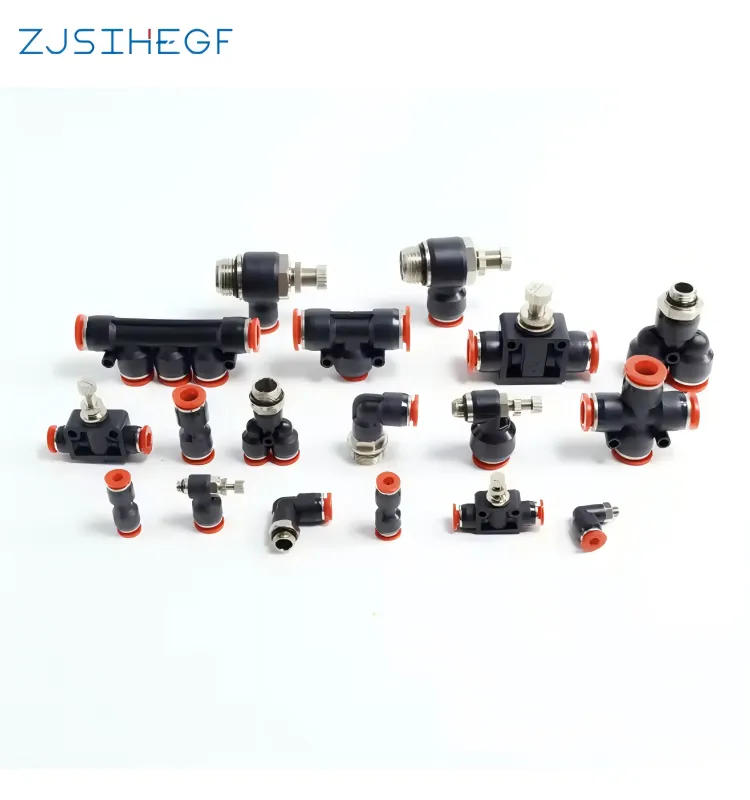
Pneumatic quick connect fittings often appear in industrial workshops, automobile repair shops and DIY family projects. If you ‘ve ever felt flustered switching from an impact wrench to a tire inflator, you ‘ll understand the frustration of poor connectivity. These connectors are not just handy accessories ; they are the key components that determine the safety, efficiency and life of the entire compressed air system.
In this article, we ‘ll discuss in detail everything you need to know about selecting, installing and maintaining the right connector. Whether you ‘re optimising your plant production line or decorating your garage air compressor, understanding the mechanical principles of these fittings is the first step in achieving a ‘zero leakage’ environment.
What Are Pneumatic Quick Connect Fittings?
Pneumatic quick connect fittings, commonly known as air couplers or push-to-connect fittings, are mechanical devices that can quickly connect and disconnect pneumatic tools, hoses and pipes without manual tools such as wrench.
Understand its core functions : they allow modular flexibility while maintaining air pressure. When the fitting is disconnected, the internal valve usually immediately seals the air flow to prevent pressure loss, a function known as ‘shut-off’.

Why Are They Essential?
Time Savings: Replacing tools takes seconds, not minutes.
Safety: If a safe fitting is used, safe pressure relief is allowed that reduces the risk of hose flicking.
Efficiency: High-quality fittings minimize pressure drop and ensure your tools get the power they need.
How Do Pneumatic Quick Connect Fittings Work?
To understand how to use them, you must first understand their mechanisms. A standard component consists of two parts: the socket (female) and the plug (male).
The Socket: usually connected to the gas source (hose or compressor). It contains a spring-loaded sleeve.
The Plug: Connect to the tool. It has a contour of a specific shape that can be locked into the female head.
When you push the male head into the female head, the sleeve will bounce back and lock the ball bearing on the groove of the male head. This forms a solid mechanical seal. At the same time, the internal valve is opened to allow compressed air to flow through.
Types of Pneumatic Quick Connect Fittings
Industrial Interchange (Type M)
This is the most common type in the United States and many general industrial environments and in home garages.
Color Code: Usually brass or silver.
Applications: General purpose, DIY, light industry.
Pros: Widely available and lower price.
Automobile Standard (Type T)
It is often confused with M-type, but its outline is slightly different.
Color Code: Usually blue (in some modern brands) or brass.
Application: Car repair shop.
Pros: More durable in high vibration environments.
ARO Interchange (Type A)
Applications: Construction and fleet services.
Prominent Features: The front end of the male head is longer and thinner than the M-type.
High-flow (Type V)
Applications: HVLP paint gun, high torque impact wrench.
Pros: Designed to allow more CFM (cubic feet/min) through the fitting that reduces tool power shortage.
SUOMANG Expert Tip : Never forcibly insert the male head into the female head. If it cannot be easily stuck, it is likely that the model does not match.
Material Matters: Brass, Steel, or Composite?
When selecting pneumatic quick connect fittings, the material determines its service life and environmental adaptability.
| Pneumatic Quick Connect Fittings Material Table | |||
|---|---|---|---|
| Material | Durability | Corrosion Resistance | Best Use Case |
| Brass | Moderate | Good | General purpose, indoor workshops. Soft metal seals well. |
| Stainless Steel | High | Excellent | Food processing, medical, or marine environments. |
| Steel (Plated) | Very High | Low to Moderate | Heavy-duty industrial tools where impact damage is likely. |
| Composite/Plastic | Low | High | Light duty, automation lines, and “push-to-connect” tubing systems. |
For detailed engineering standards on material properties, you can refer to the Engineering Toolbox, which is a reliable resource on the thermal and physical properties of materials.
Push-to-Connect Tubing vs. Tool Couplers
It is very important to distinguish two types of pneumatic quick connect fittings:
Hard Tool Couplers
These are the above-mentioned heavy metal fittings (M-type, T-type, etc.) for handheld tools (such as nail guns and impactors).
One-Touch Connector
These are used for automation and pneumatic wiring (usually nylon or polyurethane tubes).
How to use: Just push the plastic pipe into the fitting. The internal jaws will catch the tube.
How to release: Press the release ring (shaft ring) on the fitting body, and then pull out the tube.
Common Size: 6mm, 8mm, 1/4 ‘, 3/8 ‘.
How to Install Pneumatic Quick Connect Fittings Correctly?
Improper installation is the main cause of ‘hissing’ everywhere in the workshop. Operate according to this step-by-step process to ensure perfect sealing.
Step 1: Identify the Thread Type
Most pneumatic fittings use NPT (National Pipe Taper) thread. These threads become tighter and tighter when screwed in. Make sure that NPT is not mixed with BSP ( inch pipe thread ), otherwise it will slip.
Step 2: Use Threaded Sealants
The thread must be sealed to prevent air escaping through the screw gap.
Teflon Tape: clockwise winding 2-3 circles ( looking at the direction of the thread ). Do not let the tape go beyond the end, otherwise the debris may enter the pneumatic tool.
Liquid Sealant: it is usually better in a high vibration environment.
Step 3: Tighten Properly
Tighten the fitting with your hand, and then twist it 1.5 to 2 times with a wrench.
Warning: Excessive tightening of brass pneumatic quick connect fittings may cause the fitting body to break.
Step 4: Test for Leaks
When the system is pressurized, soapy water is sprayed at the fitting. If bubbles form, re-tighten or re-use the sealant.

Common Troubleshooting
Even the best system will fail. Here are the answers to common questions about fitting failure.
Why does the fitting leak when disconnected?
If the tool is pulled out, the mother head is leaking, indicating that the internal O-ring or valve seal is damaged. This is common in dirty workshops where dust is easily stuck in seals.
Solution: Try to drop a few drops of pneumatic tool oil into the connector to lubricate the seal. If invalid, please replace the mother head.
Why does the fitting break under pressure?
This is a security risk. It usually means that the ball bearing in the parent head has been worn, or the locking groove on the male head has been rounded.
Solution: Discard and replace the male and female heads immediately.
How to stop the ‘bang’ when disconnecting?
Huge bangs are the sound of trapped air escaping.
Solution: Upgrade to ‘safety fitting’ or ‘zero pressure’ fitting. These two-stage fittings discharge downstream pressure before releasing the tool that prevents hose churning and noise.
Maximize Air Flow Efficiency
Many users blame the air compressor for the lack of power, but it is not known that the culprit is actually the pneumatic quick connect fittings.
The standard 1/4 ‘coupler (M-type) flow rate is about 30-40 CFM. However, the demand for large 1/2 ‘ impact wrenches may soar to a higher level. The blockage at the connector will reduce the torque of the tool.
Optimization Strategy:
- Use High-Flow Fittings (Type V): These maintain a 1/4 ‘ NPT thread, but the internal airway is wider.
- Shorten the Length of the Hose: long hose with restrictive fittings will stifle performance.
- Upgrade to 3/8 ‘ Fittings: If you ‘re running heavy tools, upgrade from standard 1/4 ‘ to 3/8 ‘ for a significant flow boost.
Conclusion

Choosing the right pneumatic quick connect fittings is not just as simple as taking one on the shelf of a hardware store. It needs to match the type (industrial and automotive), material (brass and steel) and flow requirements according to your specific tools.
By investing in high-quality fittings and following the correct installation protocol, you can ensure a safer working environment and extend the service life of expensive pneumatic tools. Don’t let a fitting worth $ 5 destroy the performance of an air compressor worth $500.
FAQ
Are all pneumatic fittings universal?
No. Although they look similar, different contours ( Type M, Type T, Type A, Type V) are not interchangeable. Mixed use can lead to leakage and safety hazards.
Can I use raw tape on all pneumatic fittings?
You should use a raw belt or sealant at the thread end ( NPT ). However, do not use tape in the quick connection part ( male / female mating surface ).
How often should I change the connector?
In the daily use of commercial workshops, it is recommended to replace it once a year or when there are signs of wear and tear. In a family garage, they can be used for many years if they are kept clean and oiled.